





















































Best Printers for Vehicle Graphics: Wraps, Fleet Graphics, and Decals

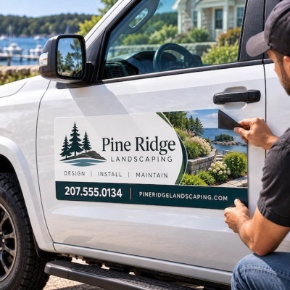
Vehicle graphics is one of the most requested applications in wide-format printing: full car wraps, fleet graphics, and decals. The right printer for the job depends on what you print most, how much volume you run, and whether you need white ink, a built-in cutter, or the fastest path from print to laminate. This page walks through the current lineup and explains the ink technologies behind them.
What Makes a Printer Good for Vehicle Graphics
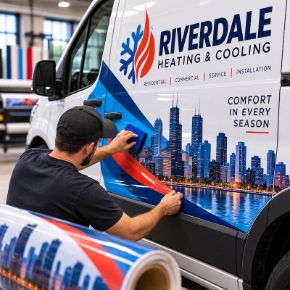
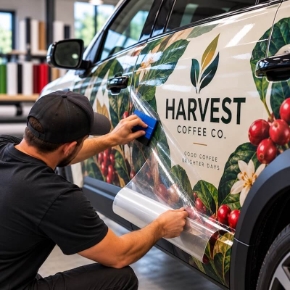
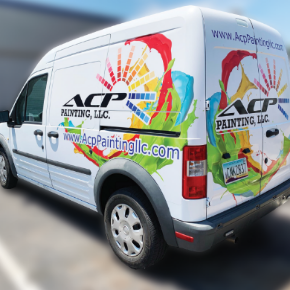
A vehicle wrap lives outdoors, stretched over curves, rivets, and body lines, washed, sun-beaten, and expected to hold color for years. That sets the bar higher than a banner or a poster. Four things matter most. First, outdoor durability: the ink and laminate combination has to stand up to UV and weather. Second, conformability: the print has to stretch and settle over compound curves without cracking or lifting, which is as much about the vinyl and laminate as the ink. Third, color: fleet work and brand graphics need the same color on vehicle ten as on vehicle one, and again on the reprint six months later. Fourth, width and speed: most wrap work runs on 54-inch vinyl, so a 64-inch printer covers it with room to spare, and faster output means more vehicles through the bay.
Solvent vs Latex vs Resin for Wraps
Three ink technologies cover nearly all vehicle graphics work, and each earns its place differently.
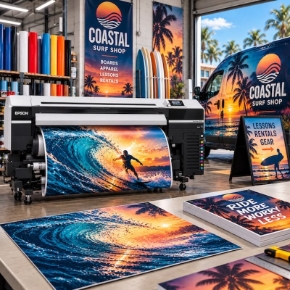
Solvent (Epson S Series). Solvent ink bonds to the media through a chemical reaction, with gentle heat under 135 degrees. Prints are dry to the touch in minutes, and Epson S Series prints are laminate-ready in 4 to 6 hours. Solvent needs solvent-coated media, runs on standard 110V power, and delivers deep, rich color at a lower ink cost per square foot. The tradeoff is odor while printing and a lamination wait before the wrap goes on the vehicle.
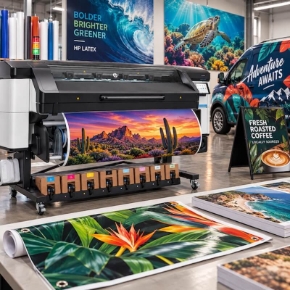
Latex (HP Latex). Latex ink is water-based: the water is evaporated at around 240 degrees, leaving a resin polymer film on the media. Prints come out instantly dry and ready to laminate immediately, with no odor and zero harmful VOCs. That film also gives the print instant scratch resistance and the elasticity a wrap needs to stretch over curves. Latex prints on a wider range of media, including uncoated vinyls, but uses roughly 30 percent more ink per square foot than solvent and needs two 220V outlets.
Resin (Epson R5070). Resin is Epson's third path: a 6-color resin ink set plus optimizer that prints across signage, wallpaper, fabric, and uncoated media, with immediate lamination and high scratch resistance. Its calling card for vehicle work is color consistency: repeat jobs, brand colors, and multi-panel work that has to match panel to panel and reprint to reprint. Ink runs about 15.5 cents per milliliter in 1.5L bulk packs.
The Current Lineup in 2026
Prices shown are regular prices. Additional savings are available through Epson and HP promotions that vary from month to month, so see the current pricing information at the top of each product page or call 1-800-771-9665.
| Printer | Ink | Best for | Regular price |
|---|---|---|---|
| Epson S7170 | Solvent | Entry-level 64" solvent, wraps and decals | $16,065 |
| Epson S8170 | Solvent | Mid-tier solvent, higher speed and volume | $23,685 |
| Epson S9170 | Solvent | Flagship solvent, widest gamut, white ink standard | $28,835 |
| Epson R5070 | Resin | Repeatable color, fleet and brand work | $24,195 |
| HP Latex 630 | Latex | Entry-level latex, instant-dry wraps | $16,445 |
| HP Latex 630W | Latex + White | Entry latex with white ink | $19,745 |
| HP Latex 730 | Latex | Mid-tier latex, faster fleet output | $21,845 |
| HP Latex 730W | Latex + White | Mid-tier latex with white ink | $26,595 |
| HP Latex 830 | Latex | Flagship latex, high-volume production | $32,345 |
| HP Latex 830W | Latex + White | Flagship latex with white ink | $34,595 |
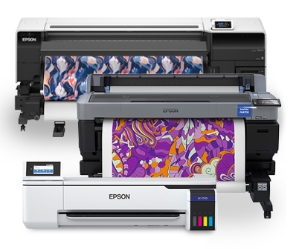
Epson SureColor Solvent: S7170, S8170, S9170
The S Series is the solvent path into wraps. The S7170 is the entry point at 64 inches, printing banners at 280 and vinyl at 140 square feet per hour, with ink around 21 cents per milliliter. The S8170 steps up to 358 on banners and 243 on vinyl, with ink around 19 cents per milliliter. The S9170 is the flagship: 11-color UltraChrome GS3 ink including Red and Green, up to 99 percent PANTONE coverage, vinyl at 215 square feet per hour, ink around 17 cents per milliliter, and white ink standard. A print-and-cut edition of the S7170 is also available for shops that want to print and cut decals on one machine.
HP Latex: 630, 730, 830 (and the W White-Ink Models)
The Latex lineup is the instant-dry path into wraps. The Latex 630 is the entry model, printing banners at 194 and vinyl at 118 square feet per hour, with ink around 16.4 cents per milliliter. The Latex 730 moves up to 334 on banners and 226 on vinyl. The Latex 830 is the flagship, with 3L ink cartridges and the lowest running cost in the family at about 15.3 cents per milliliter including printheads. Each tier has a W model with white ink, the 630W, 730W, and 830W, for printing on clear, colored, and metallic films, plus window graphics. Print-and-cut bundles are available on the 630 and 630W for decal work.
Epson SureColor Resin: R5070 and R5070L
The R5070 runs Epson's 6-color resin ink set plus optimizer at up to 1200 by 2400 dpi, with user-replaceable PrecisionCore printheads, immediate lamination, and high scratch resistance. It prints signage, wallpaper, fabrics, and uncoated papers as well as vinyl, which makes it a versatile second machine for a wrap shop that also does interior and display work. The R5070L is the higher-capacity version of the same platform. Both run on 200 to 240V power.
HP Latex Flatbeds: R1000 and R2000
The R1000 (64 inch) and R2000 (98 inch) are latex flatbed printers for rigid media. They are not wrap printers, but they sit in the same category because a shop doing vehicle graphics often does the rigid work around it: fleet signage, panels, and display boards. Worth knowing about if your shop covers both sides of the job.
Our Picks for Vehicle Graphics
| Award | Printer | Why |
|---|---|---|
| Best quality | Epson S9170 | Current flagship solvent, up to 99% PANTONE coverage, white ink standard |
| Lowest cost of entry | HP Latex 630 or Epson S7170 | The entry 64" latex and solvent machines |
| Best for repeatable color | Epson R5070 | Resin ink built for consistent color across fleet vehicles and reprints |
| Best overall | HP Latex 830W | Current flagship latex with white ink, 3L cartridges, and the lowest running cost in the Latex family |
What Else You Need: Media, Laminate, and Cutting
The printer is only the first half of a wrap. A finished vehicle graphic needs the right vinyl, a protective laminate, and a way to cut it to shape.
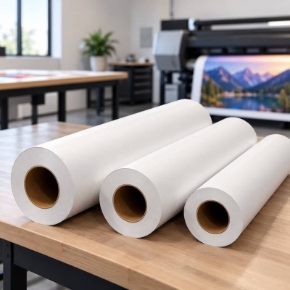
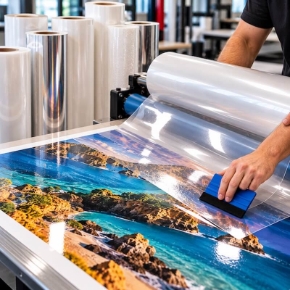
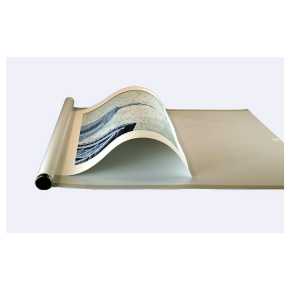
Wrap vinyl. Cast vinyl is the standard for full wraps and compound curves, because it conforms and holds. Polymeric and calendered films suit flatter panels, fleet lettering, and shorter-term graphics at a lower cost. Our media lineup includes General Formulations AutoMark cast and polymeric wrap films, Avery MPI1105 cast vinyl, and Avery MPI 2105, 2902, and 2921 calendered films, in 54-inch rolls to match a 64-inch printer. Browse Media for Vehicle Graphics
Laminate. Lamination protects the print from UV, abrasion, and weather, and it is what makes a wrap last outdoors. Gloss and matte overlaminates are available, including Avery DOL1060Z gloss and DOL1080Z matte cast films, which are built for maximum protection and conformability over rivets on flat or compound curves. Browse Wrap Laminates
Cutting. Decals, lettering, and contour-cut graphics need a cutter. Print-and-cut bundles pair the printer with cutting in one workflow: the S7170 Print and Cut edition and the HP Latex 630 and 630W Print and Cut Plus solutions. For full wraps, cutting is usually done by hand during installation, but a plotter earns its keep on every decal and fleet lettering job.
Which One Fits Your Shop?
- Starting out in wraps: the Latex 630 or the S7170. Both are 64-inch machines at the entry price point, and both cover full wraps and fleet work. Pick latex for instant lamination and no odor, solvent for lower ink cost.
- Growing fleet and brand work: the Latex 730 or S8170 for more speed, or the R5070 when repeatable color across vehicles and reprints is the priority.
- High-volume wrap production: the Latex 830W or S9170. Flagship speed and capacity, with white ink for clear and specialty films.
- White ink needed: the 630W, 730W, or 830W on the latex side, or the S9170 on the solvent side.
Frequently Asked Questions
What is the best printer for vehicle wraps?
There is no single answer, but the short list is the HP Latex 830W for overall production, the Epson S9170 for the best solvent quality and color gamut, and the Epson R5070 for the most repeatable color across fleet vehicles and reprints. The right pick depends on your volume, whether you need white ink, and how fast you need prints laminated and out the door.
Is solvent or latex better for vehicle graphics?
Both produce professional wraps. Solvent costs less per square foot in ink and runs on standard 110V power, but prints need 4 to 6 hours before lamination on Epson S Series machines. Latex prints come out instantly dry and laminate immediately, with no odor and a stretchy resin film that suits curves, but latex uses roughly 30 percent more ink and needs two 220V outlets. If same-day turnaround matters, latex has the edge. If ink cost is the priority, solvent does.
Do I need white ink for vehicle graphics?
Only if you print on clear, colored, metallic, or dark films, or do window graphics. For standard white wrap vinyl, white ink is not needed. If you do need it, the white models are the HP Latex 630W, 730W, and 830W, and the Epson S9170, which includes white as standard.
Do I need a cutter for vehicle graphics?
For full wraps, most cutting happens by hand during installation. For decals, lettering, and contour-cut graphics, a cutter is essential. Print-and-cut bundles are available on the S7170 and the Latex 630 and 630W.
What width printer do I need for wraps?
Most wrap vinyl comes in 54-inch rolls, so a 64-inch printer covers it with room to spare and lets you run narrower rolls side by side. That is why nearly every machine in this category is 64 inches wide.
What media and laminate do I need?
Cast vinyl for full wraps and compound curves, polymeric or calendered vinyl for flatter panels and shorter-term fleet work, and a cast overlaminate for UV and abrasion protection. Our vehicle graphics media lineup covers all three, including General Formulations AutoMark and Avery MPI films and DOL overlaminates. Browse Media for Vehicle Graphics
Talk Vehicle Graphics With Our Team
Not sure which printer fits your wrap volume, or what media and laminate your jobs need? Our specialists can walk through it.
Call 1-800-771-9665 Browse Vehicle Graphics Printers Browse Vehicle Graphics Media